Friday, April 6, 2012

Biking Beatles - A Collection

 Feel good about riding your bike, whoever you are and wherever you are.
For those of you that ever felt silly while riding your bike, especially in the United States. Yes, we do feel that way here in cities like Anchorage, Miami, Houston and others  where the motor vehicle is king. Those cities might have many other wonderful things, but pedestrian friendliness is not one of them. To make my point more clear, in case any of you out there wants to prove me wrong, I will give you an example. It is 7:14 and you start work at 8:00am. You are all dressed up for your presentation. You put your briefcase on the rack or the front basket and start pedaling towards the office.  Everything is nice and dandy and you appreciate that sense of freedom, but more than that, you feel goooood about being able to commute without adding one single molecule of CO2 to the atmosphere; in fact you wish your neighbours saw you so you can shove it in their faces that you don't need that brand new Ford Explorer or 4-Runner to move around town. That's all perfect until you get to the stop light. As you have to stop and the cars start to pile up next to you with your suit and tie, you start to sweat, but not from pedaling. Now tell me if that hasn't happened to you. That is how it feels like to commute to work in cities like Orlando or Detroit. 
 Traffic makes you feel silly because all those people are looking at you and you know what they are thinking.  "Who, in their right mind would bike to work on a suit and tie?" Well YOU DO, so what? I think when that happens to me.  You are the ones that should feel silly driving those gas suckers and getting fat as you pollute my air. You are the silly ones paying those huge car loans and $4+ per gallon of gasoline for a car that holds 7 while only you are seating on it.  Me? I only consume what I need, I exercise, feel good and don't work for my car to look good in the parking lot.
So, having said that, I will show you how cool the bicycle can be. So cool that even the ultra Beatles thought it was a cool way of riding.  Enjoy :)

These are the Beatles in the Bahamas while filming Help in 1965. Not the best experience for them since Director Richard Lester throughout the whole movie, made them feel like a bunch of extras. How silly do you think John Lennon felt while kissing Yoko Ono? Do you really think he cared? I don't.  The other pictures of the Ringo or Paul are not from that time.

Thanks to:
Boston Raleigh Users Group
Corbis
Beatles day by day
piubici.tumblr.com
KPBS
Greenmuseum.blog
DL1.blogspot.com
Bikes and the City
john Lennon Quotes.net
Movie Moron

Wednesday, April 4, 2012

Does this look Dangerous to You?

I came across the posting that I translate below and couldn't help it but to  include it in my blog because of two reasons. The first is that I find it very practical to have a bicycle for you that also allows you to carry your offspring :). The other reason is that I wanted you to see how in some places like Madrid, Bogota, some cities in Australia, the government is so out of touch with the rest of the world that instead of becoming a catalyst for positive change, opts to harass citizens and in particular those that are really contributing to make the city a better place; those that are doing something for the environment, those that don't pollute.  Those are the citizens that have to explain themselves in front of city government officials. Our subject today is Olly. Olly Green is having to fight a battle against city government to be able to take his daughters to school on his bicycle. I guess I want you to tell me where is the harm in this for the city, for him or for his daughters. Maybe I am the only one who does not see it.
Here is the translation from his blog Por Pozuelo con Pedales:

"Last week the police pulled me over for taking my daughters to school on my bicycle. Outside the school two police officers awaited me, dressed in civilian clothes and a car with no markings. In a quite aggressive way they were telling me that the bicycle was not appropriate to carry two children and demanded the technical book for the bike, which is ridiculous since it does not exist. The bicycle is a Kemper Pack Max Duo with a Bobike Junior seat and a Bobike Maxi seat; both compliant according to European code. My daughters are two and five respectively.  My daughters are two and five respectively.

After protesting (I was really furious), they decided to mess with me for covering part of the route over the sidewalk (some 200mt)… I know it is not permitted, but when I take my daughters I take the sidewalk for part of the Avenida Juan XXIII, an avenue of high risk from cars. I have decided that it is better to get light citation than my daughters’ lives - given the lack of adequate infrastructure for cyclists and the inaction of police to enforce traffic laws such as a maximum speed of 40km/h or the 1.5m margin that cars must allow when passing a bike. Even the police themselves told me to go by the sidewalk with the girls one day as we came from school.

¡They will report me to the Social Services!
The issue resulted in them taking my information and issuing a report for City Hall and another for the Social Services for being an irresponsible father; such a nonsense and absolute abuse of authority. For years I have been using the bicycle every day as a method of transportation and I’ve taken my daughters to school on the bike from the day they could sit up.

I want people to know
I am indignant, indignant for having to put up with this non-sense; (even more when there are cars breaking all kinds of laws), with the lack of respect to cyclists, the grave lack of adequate infrastructure, the bad use of public funds and police resources, etc.; this, in contrast with other Spanish cities like Vitoria, Barcelona, Seville, Valencia or Majadahonda, which are actively promoting the use of the bike. What a shame."

Wednesday, March 28, 2012

If Only We...

If Only We... that's the title of my post because as you look at the video, everything makes so much sense, then you come back to the America and I mean the entire continent and reality hits you in the face. Conspicuous consumption gets in the way of freedom. Little did we know that our struggle for economic independence was coming with a big price tag - our health and our dependence on the motor for transportation. Has it happened to you that the rare occasion when your car is in the shop becomes a big logistic nightmare? If the shop does not offer to take you to wherever you need to go by way of a shuttle, you have to make phone calls, talk to your boss, etc. Why not just take the bike and go? Why not just ditch the car?


That's all easier said than done. We all have so much to do, so many places to be in one day and who wants to get there all sweaty? Well, Amsterdamers don't seem to have a problem with it, so you know what? that's my next destination - Amsterdam. I will go, see for myself, come back and tell you. So far every video you see on the web tells you how great it is to live in Europe for that one reason, but why don't we try to understand the infrastructure? Maybe that way one day when I have to go back to the hearings at the municipality, I can put it in her face to the woman that had the nerve to say two years ago that "we don't need more bicycles and who is going to pay for those stupid bike lanes?"

Friday, March 16, 2012

Bike Sharing Around the World

Well, I just came back from Washington DC and while there I decided to try the Bike Share system and here is the scoop. Great system as far as availability. The bikes are quite heavy, but sturdy, to the point of being dangerous if you hit a pedestrian and you will certainly damage a car if you collide with it with your bike. That said, they come equipped with all the safety features you need: Back lights, bell, reflective tires, plus three gears, basked, adjustable seat. The bikes are clean, good looking and inviting. One little thing I didn't quite like was the pricing scheme.  The ticket dispenser that you see here in this picture tells you that if you want to be a member for one day, you will pay $7 for the membership plus the time you ride if it is more than 30 minutes. Well I though, not as cheap as I thought, but OK I will go ahead and rent one for me and one for my coworker since the system lets you rent two bikes with one credit card.

Then I get home to find out that Capital Bikeshare of Portland charges you $7 per bike while it also puts a $101 dollar security deposit on your bike for a week. If you ride less than 30 minutes, the ride is said to bee free, but it really is not. Riding a bike for less than 30 minutes for $7 is not fee and for the company to keep $101 as a security deposit for a week is not cool either.  That is not to say that I don't applaud the fact that the District of Columbia came to modernity by adopting this bike riding system, this is only to say that the price scheme is not really friendly to the visitor. Now, to be fair, I have to say that I saw a few young fellows coming by my and taking the bikes that I was trying to rent with just shoving a plastic key in the side of the rack to free one of the red bicycles. Some of them even told me that they had a whole year pass that cost them $35 through a coupon/gift from their employer. yoohoo I said. More power to you.  To say the least, the system rocks, even when I don't like their price strategy to squeeze money out of tourists; and since we are on that topic, let me give you something interesting. First, the map of all or most of all the bike-sharing points around the world that I got from the Bike Sharing Blog.

Click on the map you will be able to see almost, if not all the bike-sharing stations around the world. 
The second little nice thing I have here is a website called Bike Share Philadelphia, which has a section with videos of a bunch of bike-sharing sites around the world. 
Between these two, you will be able to gather all the information about bike-sharing that you want. Enjoy and please send me your comments.


Friday, March 9, 2012

Fillet Brazed - Welded or Lugged Frame?


Bronze
 I always wanted to know why some frame makers use one or another technique to put bike tubing together.
Well, as I have found, no individual technique is necessarily better than another. It all depends on the needs.

The frame shown here is brazed. The American Welding Society (AWS ), defines Fillet Brazing as a group of joining processes that produce coalescence of materials by heating them to the brazing temperature and by using a filler metal (solder) having a liquidus above 840°F (450°C), and below the solidus of the base metals.


TIG Welding or Tungsten Inert Gas welding. A form of welding by the use of an electric arc. The area being heated is bathed in an inert gas (argon?) to prevent oxidation. T.I.G. welding is commonly used to build lugless bicycle frames. Most current bicycle frame production is done by T.I.G. welding.
Lugged: A lug is a socket that forms the junction between two or more frame tubes. Traditional bicycle construction uses steel tubes and lugs, joined together by brazing or silver soldering so that the space between the tube and the lug fills up with molten brass or silver alloy. Some aluminum or carbon fiber bicycles also use lugs, with glue instead of the brass or silver.

"Fake" Lugs:  Also called bi-laminate. These "lugs" are created by hand as the bike was fillet brazed. The frame is intentionally given the appearance of a lugged frame, but is produced with by a much more time consuming process. The pictures (left) from Gallus Cycles in Texas was made with bi-laminate, but by wrapping a sleeve around the tubing to then cut out the shapes once the pieces are brazed. It doesn't seem to add any strength, but it certainly looks smooth.
Bi-lam originates from post-war Britain and was pioneered by Claude Butler. It started primarily due to the lack of materials after the war. Originally the “lugs” would start out as a flat sheet of metal with a design cut out of it. After the frame was fillet brazed, the sheet would be wrapped around the tube and brazed in as well. It the gives the impression of a lug.
Now, you might be wondering, how strong are these frames and why would frame builders choose to use one or the other. I have tried to compile some definition of all three techniques to give an idea.
 Basically, you can use any of the methods. It might depend on preference and the look that you are trying to obtain. This last picture shows a forced break weld. Notice how the tube breaks above the joint. Wow...hard core stuff.


Brazing vs. Welding


Welding joins metals by melting and fusing them together, usually with the addition of a welding filler metal. The joints produced are strong, usually as strong as the metals joined or even stronger. In order to fuse the metals, a concentrated heat is applied directly to the joint area. This heat is high temperature. It must be - in order to melt the "base" metals (the metals being joined) and the filler metals as well.
So welding temperatures start at the melting point of the base metals. Because welding heat is intense, it is impractical to apply it uniformly over a broad area. Welding heat is typically localized, pinpointed heat. This has its advantages. For example, if you want to join two small strips of metal at a single point, an electrical resistance welding setup is very practical.

Taipei International Bicycle Show 2011

This is a fast, economical way to make strong, permanent joints by the hundreds and thousands. However, if the joint is linear, rather than pinpointed, problems arise. The localized heat of welding tends to become a disadvantage. For example, suppose you want to butt-weld two pieces of metal - start by beveling the edges of the metal pieces to allow room for the welding filler metal. Then weld, first heating one end of the joint area to melting temperature, then slowly traveling the heat along the joint line, depositing filler metal in synchronization with the heat. This is a typical conventional welding operation. Let's look at its characteristics.
It offers one big plus - strength. Properly made, the welded joint is at least as strong as the metals joined. But there are minuses to consider. The joints are made at high temperatures, high enough to melt both base metals and filler metal. High temperatures can cause problems, such as possible distortion and warping of the base metals or stresses around the weld area. These dangers are minimal when the metals being joined are thick. But they may become problems when the base metals are thin sections. High temperatures are expensive as well since heat is energy, and energy costs money. The more heat you need to make the joint, the more the joint will cost to produce. Now consider the automated process.
What happens when you join not one assembly, but hundreds or thousands of assemblies. Welding, by its nature, presents problems in automation. We know that a resistance weld joint made at a single point is relatively easy to automate. But once the point becomes a line - a linear joint - the line has to be traced. It's possible to automate this tracing operation, moving the joint line, for example, past a heating station and feeding filler wire automatically from big spools. But this is a complex and exacting setup, warranted only when you have large production runs of identical parts.
Of course, welding techniques continually improve. You can weld on a production basis by electron beam, capacitor discharge, friction and other methods. But these sophisticated processes usually call for specialized and expensive equipment and complex, time consuming setups. They're seldom practical for shorter production runs, changes in assembly configuration or - in short - typical day-to-day metal joining requirements.
Welding vs. Brazing considerations
1. Size of assembly?
2. Thickness of base metal sections?
3. Spot or line joint?
4. Metals being joined?
5. Final assembly quantity needed?

Credits: Oldmountainbikes.com
lucasmilhaupt.com
galluscycles.wordpress.com
ptmbikes.cl.blog

Tuesday, February 21, 2012

Regarding Mandatory Helmets? My thoughts exactly

You can also watch another funnier version, but with the same message.  Australia and Bogota don't seem to take the world's feedback and trends into consideration when designing and imposing their bike riding laws.

Friday, February 17, 2012

The Rhoades and Other Pedal Cars

Given that this has become my most popular post, I have decided to augment it with a few photos of potential chassi constructions for the pedal cars you see below.  this first one is a recumbent or so called by its manufacturer. This is a home made vehicle. Quite nice for the fact that is is all PVC tubing. I suppose that makes it very light. I personally like the second one better. This second pedal car is made by Mourad Feki. I did say before that he was based in france, but I was wrong. Mr. Feki is in Tunisia. I will even give you his web address. You might want to get more information from him: http://sites.google.com/site/pedalcars/home. 

The third specimen that we have here is a Rhodes pedal car for industrial applications. I like this one in particular because it seems very robust and light.  One more advantage of getting the Rhodes is that its construction is backed by a recognized company that makes several models and very likely by a warranty. I like warranties, even when I don't like to pay for them :))

Ok this has, for a long time, been one of my most coveted dreams. How can I go to work with the same comfort of my car, 0 emissions, using the bike trail, protected from the rain, while I exercise, etc? My research took me to the pedal car.  I decided to add some other images of pedal cars that I have acquired throughout the years. Here we have a type of pedal car made in Tunisia.
I would like to see this concept widely spread and the more information we have about it the closer we'll get to creating the ultimate pedal car for adults.  The black and the red pedal car with the child are made by Mr. Mourad Feki and I will even give you his address in case you want to contact him: ph# 2-162-268-1706, Feki_consult@yahoo.fr
Pimped out Rhodes Car
There are several kinds of pedal cars. Some of them don't have a roof, some are too heavy, some are slow, etc. In any case, I found one that might just suit my needs. On a Rhoades car, the Bicycle Forest built this pimped out Rhoades pickup truck. I frankly would prefer the Volkswagen since it is not as wide and it looks more professionally built.
Morgan SuperSport Junior
The problem is that this red one is child-size.  Well, I leave you here with a compilation of pedal cars that you might have seen before. If you want to e-mail me your ideas on how we can make the perfect adult-size pedal car, I might be willing to subsidize it. 
Here we have the Morgan VW bus pedal cars. I can see it perfectly doable for adults to ride a large size model. What do you think? 
WV Pedal Car

I also found an interesting picture in the Vanhat Velot blog. It is similar to the Morgan above. Of course I don't understand a word of what they say here and the 2008 volume is not for sale. I wanted to see more details of it. For now here you  have the picture of it.

Don't hesitate to send your comments.
Enjoy :)

Thanks to the Samba.com and The Bicycle Forest.

Monday, February 6, 2012

Making use of Availble Technology


The Wee Ride's Kanga
Kanga by Wee Ride from Australia
Very appropriate for those of us that are expecting or that already have children. Why not just appropriate, but very appropriate? well because I used to think that the coming of children would stop me from doing all the things that I like and the main one would be  riding my bike. Well, as I am coming to find, there is a ton of devices out there for your child or perhaps for you to carry your child.
 

Tyke Toter
  

Safe T Seat on a Public Bicycle

These two devices called my attention for their simplicity, practicality and for being inexpensive. With only one bolt either in the front or back of the bike, Tadaaaaaaa!!!! you are in business... in the bike riding business with your child.


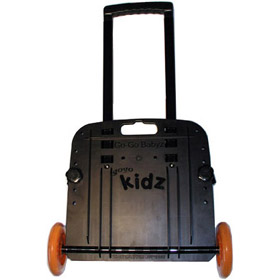
Go Go Babyz

Go Go Babyz
 This cool suitcase-like carrier amazed me at the Minneapolis Airport as the one cool mother pulled child and seat mounted on the Go Go Babyz carrier to then board the plane and stow it in the overhead compartment as if nothing. This is also an inexpensive device that will free you from having to carry those bulky wheels from place to place. - Enjoy :)


How fancy can this be? Look at how this mother can convert her Taga stroller into a Taga tricycle and back. or if you look at the even smaller seats above, all you have to do is attach them to the front or to the back of the bike and you won't have to buy another bike or any other fancy devices for your child to accompany you. For around $60 to $80 you will be completely set. 

I hope you find this research useful. Happy riding :)

Friday, January 27, 2012

Bicycling and Walking in The United States

From the Alliance for Biking and Walking comes:
the Bicycling and Walking in the United States 2012 Benchmark Report. Click on the image to access the full report.


The Economic Impact of Bicycling and Walking As economic recession has impacted communities across the nation, active transportation has emerged as a promising sector for growth and revitalization. Bicycling and walking projects create 11-14 jobs per $1 million spent, compared to just 7 jobs created per $1 million spent on highway projects. A series of case studies in 2010, examining the construction of U.S. bicycle and pedestrian facilities, found that such projects created between 218 and 1,050 new construction jobs.
After an initial economic boost from construction, pedestrian and bicycle infrastructure has a lasting impact on local economies. A 2009 study in Minnesota found that bicyclists on state trails spend $2.4 billion annually, supporting nearly 31,000 full- and part-time jobs. A survey of San Francisco business owners on Valencia Street found that two-thirds of merchants thought the street's bike lanes had an overall positive impact on their business or sales.
Bicycling and walking also results in significant cost savings on health care spending. If just one out of every 10 adults started a regular walking program, the U.S. could save $5.6 billion in health care costs — enough to pay the college tuition of more than 1 million students. Thanks to bicycle infrastructure and programming, the City of Portland expects to see between $388 and $594 million in health savings by 2040. Cost benefit analysis show that as much as $11.80 in benefits can be gained from every $1 invested in bicycling and walking.

Tuesday, January 24, 2012

Contrasting Technologies


 In recent months I had the fortune to visit the US Coast Guard installations in Elizabeth City, SC and discovered among all the hundreds and hundreds of helicopter fuselages and parts, that bikes are being used as a 0 emissions rapid commute tool between hangars. 
 
In our June 23, 2011 posting titled Bikes in the Airfield, we showed some tricycles in Elmendorf, Alaska next to an Alaska Air National Guard's HH060 Pave hawk.  What a contrast...
The only other simpler way of transporting yourself, stuff and others besides the bicycle is to walk. Yet as humble and as simple as the bicycle is, it has proven to be of use next to the most advanced of technologies such as aviation.
In any case, if you ever wonder, is there a place where bicycles just don't fit? Tell me and I will try to prove you wrong :)