Wednesday, September 19, 2012

BICYCLE FRIENDLY STATES

According to the League of American Bicyclist:

2012 State Rankings Released

Adding more excitement to National Bike Month, the League has released its latest Bicycle Friendly States ranking. For the fifth year in a row, Washington continues to lead the nation, with outstanding performance in all categories. Riding the wave of significant bicycle improvements, other states like Colorado and Delaware charged into the Top 10.

Click on the map above to explore the state ranking
“We are encouraged to see significant progress in top states like Washington, Minnesota, Colorado and Massachusetts,” said Andy Clarke, president of the League of American Bicyclists. “But, as the scores clearly highlight, there’s much work to be done in critical areas like infrastructure and funding. Overall, we see states — and especially state Departments of Transportation and state legislatures — lagging behind cities and the expectations of local cyclists, despite the many well-documented benefits of a more active lifestyle.”
The 2012 rankings mark the launch of an updated and improved evaluation process. Throughout 2011, the League held Bicycle Friendly America listening sessions across the country to understand the successes and shortcomings of the program.  Based on public input, the Bicycle Friendly State survey was revised to give a clearer picture of a state’s accomplishments and next steps towards becoming more bike-friendly.
Click here (or the image below) to see the rankings and how each state scored in the five evaluation categories.

Even with the revised survey, Washington once again set a high bar in 2012. With support from the highest levels of government, the state leads the nation in creating new bicycle infrastructure and using federal funds for bicycle and pedestrian projects. In 2011, the state passed a safe passing / vulnerable user law, due in no small part to the efforts of the Cascade Bicycle Club and Bicycle Alliance of Washington, which have some of the highest advocacy capacity in the country.
“People in the Pacific Northwest embrace bicycling as part of a lifestyle that honors the environment, healthier living and transportation choices,” said Washington Governor Christine Gregoire. “This title once again confirms that we’re on the right track, supporting bicycling as a transportation option in our communities.”
Also on the right track, Colorado and Delaware rose to #4 and #10 respectively in the 2012 rankings. Colorado exemplifies many of the qualities the League looks for in a bicycle friendly state, including a bicycle commuter mode share that’s more than double the national average, a bike-friendly department of transportation, and a top-notch statewide advocacy group.
Delaware also jumped to #10 thanks to visionary support from top government officials. With dedicated state funding for bicycling projects, Governor Jack Markell and the state departments of Transportation (DelDOT) and Natural Resources and Environmental Control (DNREC) are leading the way to create a multi-modal transportation system. And the partnership between state leaders and Bike Delaware, the statewide advocacy group, is a model for other states seeking to become more bike-friendly.
“We welcome our rise in the ranking as recognition of what we are doing to make walkable, bikeable communities a priority in Delaware,” said Governor Jack Markell, who is himself an avid cyclist. ”Trails and bike routes are a part of a vision for a state with interconnected communities. We will continue working to make Delaware an attractive place not only to bike, but to live and work.”
But the BFS program is more than an annual assessment. Throughout the year, League staff work actively with state officials and advocacy leaders to help states identify and implement the programs, policies and campaigns that will improve conditions for bicyclists. While Mississippi placed #38 in this year’s rankings, Melody Moody, executive director of Bike Walk Mississippi, is confident her state won’t be in the bottom tier for long.
“Mississippi is a state typically ranked low in bicycle friendliness, but bicycle advocates across the state are working hard to make these changes, and fast,” Moody said. “Bike Walk Mississippi is working one-on-one with local communities to provide on the ground assistance to connect leaders to tools and resources that can be used to create better and safer infrastructure, policies, plans, and programs.”
Learn more about the BFS program at www.bikeleague.org/states and stay tuned to the blog for more analysis in coming days.

My Signature

Carolyn Szczepanski
Communications Director

Szczepanski joined the League in March 2012, after two years at the Alliance for Biking & Walking. Before she crossed over to advocacy, she was a professional journalist for nearly 10 years.

Monday, September 17, 2012

Bike to Work: Anatomy of an Outfit

To continue with our topic from other posts regarding how to bike to work without the post-ride shine and what to wear, I can post some material about me and how I dress or what kind of bike I take to work, but this blog is also for women, therefore I have obtained permission from one of my hero riders to post one of her interesting reads and here you have it:


I’ve recently received several questions regarding cycling to work and what to wear. One reader also asked about the use of helmets: “I worry about having crazy lines on my head, hair out of shape… any tips or ideas on how to bike to work and not look like it once you walk in the building?”.
Since it’s back to school time (which, for us academics, is the same as back to work time), I thought it would be most appropriate to address these questions now. So here are some tips and suggestions based on my experience of biking to work in my professional clothes and while wearing a helmet. This is mostly geared towards my female readers out there since I’m speaking from my experience, which is rather limited and gender biased. I’d love to hear from the male readers out there who bike to work in their professional clothes… what are your go-to pieces or well-perfected strategies?
(Note: Whether you wear a helmet or not is your decision and should be influenced by the context of the situation. I wear one on all my commutes in my current town because of the lack of bike infrastructure and the often careless interactions between drivers and cyclists on the road. I’m neither advocating for or against helmet use, it is and should be a matter of personal choice.)
Cycling to work - anatomy of an outfit
Warm Weather Bike To Work Outfits:
1. Pattern – In hot weather, I opt for patterned garments that do a nice job of masking sweat stains.
2. Pencil skirts – I wear a lot of skirts and dresses for my professional get-ups and pencil skirts make for surprisingly good bike garments. However, they have to be made of a giving and slightly elasticized material so that there is a slight stretch to the fabric (otherwise they may be a no-go). I prefer these over fuller skirts because they stay in place better and do not blow ‘open’ while pedaling.
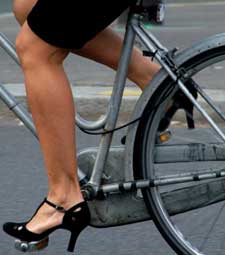
3. Heels – the beauty of cycling is that I can wear all of my shoes no matter how impractical for walking because it’s usually pretty easy to bike in them. The only ones I tend to avoid are ones with a very smooth and slippery sole which can sometimes slip off the pedal while cycling.
4. Low bun – a simple and chic ‘professional’ hairdo is the low bun at the nape of your neck. I love this look because it’s easy and quick and works well with a helmet. The helmet stays above the bun and even helps keep the top of your hair smooth and frizz-free (if you’re me, frizz is a constant enemy!) on your ride to work.
5. Bike basket – it really helps to have some kind of bike carrying system to allow you to cart your work bags not on your body. Nothing gives you major back sweat stain like a backpack on a hot day. A front basket, a rear rack, panniers…all of these will ensure that you arrive a little less sweaty and a little less wrinkly at your destination.
bike to work - anatomy of an outfit
6. Dark colors – if you’re not wearing pattern, look for darker colors to hide sweat stains on warm weather days. I also sometimes layer a wicking tank top underneath my blouse or button-down to help absorb sweat before it stains my top layer.
7. Knee length skirts or dresses - because none of my bikes have skirt guards on them, I save my longer skirts or dresses for non-cycling occasions. With fuller skirts, I love ones that are made of heavier material as they tend to blow ‘open’ less as well. This particular skirt’s hemline is trimmed with beading, which functions as a perfect weight for keeping the hem down while cycling. (With time, you come to realize what makes a great cycling item and start unintentionally filling your closet with them.)
8. Flats – as stated above, almost any shoe will do!
9. Braid – Another helmet friendly hairdo option.

perfect helmet hairdos helmet hairdo
On Helmets and Hair:
1. Braids – by far my favorite ‘helmet’ hairdo. The low braid, the ‘Dutch’ braid that wraps around, ‘Heidi’ braids that are bobby pinned in place… all of these take my messy bedhead hair and tame it into a manageable and helmet friendly hairdo. I’ve perused the Internet for inspiration and instructions and taught myself a few quick braid styles that are easy to reconcile with wearing a helmet to work.
2. Helmet - I have a Nutcase helmet (pictured above) that worked well enough but was always a little loose. I recently purchased a Giro helmet that I love because it adjusts to become tighter or looser as needed. I prefer it to the Nutcase because it allows me to adjust it for whatever hairstyle I’m sporting (‘Heidi’ braids need more room than a low ponytail) and it also allows for hat wearing in the colder months.

Winter Cycling - Anantomy of an outfit
Cold Weather Bike To Work Outfits:
1. Layers – my cold weather ‘bike to work’ outfits only differ from my warm weather ones in that I add layers. Layers are great because they allow you to adjust your temperature as your cycling or as the weather changes.
2. Boots – again, any shoes will do. In the colder months, I live in boots. In the dead of winter, I wore these faux fur lined boots along with wool socks (Smartwool are my favorite!) to keep my toes warm even in below freezing temperatures.
3. Skirts – even in the winter, I prefer skirts over pants for work outfits and will opt for tights as a way to keep warm. Sweater tights, insulated tights, or two pairs worn layered have kept me much warmer than a pair of pants might.
4. Bike Basket – although sweating is less of an issue on colder days, I still prefer to carry my work tote in a basket rather than on my back because of all the bulk that comes with winter layers. This way, it’s one less thing that I’ve got on.
5. Braids – fit nicely under a hat and equally nicely under a helmet.

Winter cycling- anatomy of an outfit
6. Helmet – this is my ‘sporty’ Giro helmet that I wore before getting my ‘stylish‘ Giro helmet. I wore this all winter rather than my Nutcase because the adjuster knob in the back allowed me to loosen it to fit over my hat.
7. Down coat – nothing beats a knee-length down coat as a top layer if you bike commute in a cold climate. I biked around town in below freezing temperatures this way.
8. Gloves – I layered two pairs on really cold days.
9. Boots – these leather boots weren’t the warmest option so I’d layer two pairs of wool socks or cashmere socks inside of them. That usually kept my toes nice and toasty enough.
10. Hat – A must under your helmet on colder days. Works well with low braids, low ponytails, or any hairdo you’re willing to redo or touch up at your destination.
There are many bike bloggers out there who commute to work in all seasons and temperatures. I’ve picked up many tricks from them and am grateful for the advice they impart on their sites. They can be found at Girls and Bicycles, Portlandize (for a male perspective!), Let’s Go Ride a Bike, Lovely Bicycle, and The Julie Blog, just to name a few. These bloggers have inspired me in particular because none lives in a predominantly warm or favorable climate and they continue cycling despite snow or rain year round.
Do you bike to work in your professional clothes? If so, what are some your tried and tested go-to items? How do you make your work wear cycling friendly?

Thursday, September 6, 2012

Head Over Heels

Could any of you give an answer to this comment below?
I am a female. A beautiful pair of heels makes me feel just as sexy as the next girl. But, unfortunately, I was born with the type of feet that end up in excruciating pain if I am standing or walking in them for anymore than 15 minutes. Alas, heels are reserved for work, any instances where I know that I’ll be able to sit for a bit, and special occasions that include my birthday, making an ex-boyfriend jealous, and a night at the club where I know I’ll be in VIP.
Hence the reason why I am mystified when I see New York women walking briskly down the sidewalk in their business suits and work outfits, strutting by me in their heels while I walk in my flats, heels tucked away in my purse until I get to work. I’ve always been bewildered at how they can look so comfortable after walking block after block, munching their morning bagel or typing away on their Blackberries. I mean, am I the only woman subject to aching feet and blisters?
Whatever the case may be, what is even more bewildering to me than New York women walking to work in their heels is…
Photo courtesy of Bikehugger.com
New York women BIKING to work in heels.
This phenomenon raises two bewildering questions for me. If anyone out there is one of these New York (or any city, for that matter) heel-wearing, bike-riding women, feel free to give me some insight to the following:
1) Why the dire need to don your heels while you bike? Why not put on some sneakers or at least cute flats and stash the heels in your bag?
2) Why are you biking to work in the first place? I mean…I get the whole added exercise bit, but…can that bike ride not wait until after work or the weekend? Or is this to save money on that monthly metro card pass…
3) This question might be due to a lack of personal coordination, but how on Earth do you even pedal without getting your heels stuck, missing the pedal all together, or losing a shoe?
No, really, inquiring minds would like to know…
Taken from http://floorthirtysix.wordpress.com/2010/05/21/head-over-heels/

Monday, August 27, 2012

A Fish without a Bicycle?

I had the suspicion that biking solved many of our problems as a society. What a vast reach. Even fish benefit from bicycling.

I came across this bumper sticker that proves my point - or does it?

I thought about asking the owner of the sticker what she meant by it, but then thought it could be quite confontational. Perhaps it is a better idea to ask a fish about the magnitude of its loss.
What is your opinion?

Wednesday, August 22, 2012

Nelly's Women's Shelter Bike Sharing Project


I came across this amazing project in Toronto.  The Nelly's Women's Shelter devised a program to provide its residents with donated bicycles.  here is their story and below I have posted some of their client's comments

“In all my life I have never had a bike.  I’m 45 now and I finally have one.  This program has changed my life!“
“I feel so proud to have a bike that’s all mine!“
“I can put my things in the basket and then I go.  To work, to shopping…it’s good!“

http://nelliesshelter.wordpress.com/


 Nellie's Women's Shelter is looking for a few generous people to help get the women and children it serves moving - on two wheels.  This summer, the east-end shelter put out a call for the donation of gently used bicycles as well as helmets, locks, bells and lights to help its clients get around town easier. Meghan Hogg, a counsellor and advocate at the shelter, serves as the new program's coordinator. "Transportation is always a huge issue for the women (and children at Nellie's). The TTC is so expensive now," said the avid cyclist, adding the lack of affordable, reliable and efficient transportation is a major hindrance for those needing to attend job interviews and other appointments. It can also be very isolating, she added. Earlier this year, Hogg started talking to her friends and contacts about the initiative. Before long, donations began rolling in as people gifted extra bikes and gear they no longer wanted or needed to the Riverdale-area organization. Hogg also posted about the initiative on various social media websites, which brought in some donations. With that success, Nellie's officially launched its new bike program this summer. "I think it's a good way for women to be able to get out of the house and the physical activity is always good," she said, adding Nellie's is looking to get a bike rack donated to the shelter as it would take far too long to get the city to pay for it.
This summer, Nellie's hopes to collect five women's bikes, 15 children's bikes and 35 locks, helmets, bells and lights.  Cash donations are also appreciated and tax receipts are available.
Also, Nellie's is currently working on forming partnerships with local bike repair businesses to help mitigate the cost to repair donated bikes and equipment in "rough shape."  Hogg, who said bikes in good working order are especially appreciated, hinted it would be extra helpful if the city stepped up to the plate and donated some memberships to its new Bixi bike rental program. The donated bikes and gear will be used by women and children at the shelter as well as by the kids in the shelter's summer camp program. Those who move out or those who don't live at the shelter, but seek assistance from Nellie's will be given the bikes and equipment.
To make a donation, or for more information about the program, email meghan@nellies.org or call 416-461-0769.
Taken from the Insidetoronto.com

Tuesday, August 14, 2012

My Mobile Medicine - Medicine on Wheels

Photo: treehugger.com

I came across this post on the treehugger.com blog and thought it was quite interesting for several reasons. First because it is about an female entrepreneur, second because it is a biker. Why did she choose a bicycle instead of a motorcycle or a  hybrid car? hmmm..., third because she is a nurse.  One of out earlier posts features an article about Emergency Response Bicycles.  The fact that this is a small business that is part of a trend makes is also interesting, so I will leave you with the post from the treehugger.com and her website address:

Registered nurse Jody Hoppis wanted more time with her patients, and a schedule that would accommodate her life as a working mom of three. So she ditched her job at a family practice clinic and set up her own nursing practice called mymobilemedicine, of medical house calls made exclusively by electric bicycle.
Photo stills courtesy Komo News.
Hoppis bikes in a 15-mile radius around the town of Bellingham, Washington, making house calls to individual patients.
Hoppis carries all of her equipment - a laptop computer and a "diagnostic bag" with stethoscope and blood pressure reader - in a custom-made bright orange bike trailer. It is modeled on a waterproof (and lockable) trailer used by Scottish postal carriers. Her Kalkhoff Pro Connect Sport e-bike provides a bit of extra power for making her rounds.
Hoppis told the Bellingham Herald that her bike-based business cuts out a lot of the overhead of a regular office, and she can not only see patients quickly as they call or e-mail requesting a visit, but spend more time with them than a busy medical office.
She makes nearly all of her patient visits by e-bike, and her Mobile Medicine web site spells out her medical philosophy, which is to treat patient symptoms, rather than just work from diagnostic tests.
It's always great to see people expanding the role of bikes in making viable businesses.

Friday, August 10, 2012

COLOMBIA WINS OLYMPIC GOLD


LONDON, Aug 10 (Reuters) - Mariana Pajon, Colombia's flag bearer at the opening ceremony, earned her country their first gold medal of the London Games when she thundered to victory in the women's BMX event on Friday.

Pajon, also the second Colombian to win an Olympic gold after weightlifter Maria Isabel Urrutia prevailed in Sydney in 2000, had dominated her three semi-final runs in awe-inspiring fashion.

She carried the momentum in the final where she led the eight-rider strong field after the first bend and never looked back, something she was happy to do at a news conference later.

"I started gymnastics when I was five, but I started BMX when I was three," she recalled, beaming with joy.

"I was doing gymnastics, BMX and cart racing. However BMX wasn't at the Olympics and I wanted to be here, then BMX was introduced in Beijing and I started training.

"I started racing when I was three and I realised I could do this and do it well. I started winning at four with the boys and won my first world title at eight."

New Zealand's Sarah Walker took silver and Dutchwoman Laura Smulders claimed bronze while local British hopeful Shanaze Reade had to settle for sixth.

She finished just behind Caroline Buchanan of Australia, the BMX time trial world champion.

"I can't believe it," said Pajon, who blew kisses to the capacity crowd. "It's like a dream come true. I've been trying to win this my whole life. I just wanted go out of the gate and win it. It's unbelievable."

On a very tricky course, Pajon once again used her explosive start to take the early lead, which proved unassailable for her rivals.

"I have tried so hard for it and I just did it," she said. "I felt really strong, I had really good gates and that's it. I really had fun on it. I have to wake up tomorrow and realise what I have just won." (Reporting by Julien Pretot; Editing by Mark Meadows and Michael Holden)


Wednesday, August 8, 2012

Women's Suffrage and the Biking Suffragettes

First of all, what is a suffragette?  Hmmm I wondered, then found out that it comes from the word Suffrage. Well according to Wikipedia:  It is the right to vote gained through the democratic process... among other rights. Well having said that, the suffragettes and their movement came to be towards the end of the 19th and beginning of the 20th centuries.

The struggle to achieve equal rights for women is often thought to have begun, in the English-speaking world, with the publication of Mary Wollstonecraft's A Vindication of the Rights of Woman (1792). During the 19th century, as male suffrage was gradually extended in many countries, women became increasingly active in the quest for their own suffrage. Not until 1893, however, in New Zealand, did women achieve suffrage on the national level. Australia followed in 1902, but American, British, and Canadian women did not win the same rights until the end of World War I.
The United States
The demand for the enfranchisement of American women was first seriously formulated at the Seneca Falls Convention (1848). After the Civil War, agitation by women for the ballot became increasingly vociferous. In 1869, however, a rift developed among feminists over the proposed 15th Amendment, which gave the vote to black men. Susan B. Anthony, Elizabeth Cady Stanton, and others refused to endorse the amendment because it did not give women the ballot. Other suffragists, however, including Lucy Stone and Julia Ward Howe, argued that once the black man was enfranchised, women would achieve their goal.
As a result of the conflict, two organizations emerged. Stanton and Anthony formed the National Woman Suffrage Association to work for suffrage on the federal level and to press for more extensive institutional changes, such as the granting of property rights to married women.  Stone created the American Woman Suffrage Association, which aimed to secure the ballot through state legislation. In 1890 the two groups united under the name National American Woman Suffrage Association (NAWSA). In the same year Wyoming entered the Union, becoming the first state with general women's suffrage (which it had adopted as a territory in 1869).
As the pioneer suffragists began to withdraw from the movement because of age, younger women assumed leadership roles. One of the most politically astute was Carrie Chapman Catt, who was named president of NAWSA in 1915. Another prominent suffragist was Alice Paul. Forced to resign from NAWSA because of her insistence on the use of militant direct-action tactics, Paul organized the National Woman's Party, which used such strategies as mass marches and hunger strikes. Perseverance on the part of both organizations eventually led to victory. On August 26, 1920, the 19th Amendment granted the ballot to American women.
Great Britain
In Great Britain the cause began to attract attention when the philosopher John Stuart Mill presented a petition in Parliament calling for inclusion of women's suffrage in the Reform Act of 1867. In the same year Lydia Becker (1827 –90) founded the first women's suffrage committee, in Manchester. Other committees were quickly formed, and in 1897 they united as the National Union of Women's Suffrage Societies, with Millicent Garret Fawcett (1847 –1929) as president. Like their American counterparts, the British suffragists struggled to overcome traditional values and prejudices. Frustrated by the prevailing social and political stalemate, some women became more militant. Emmeline Pankhurst, assisted by her daughters Christabel and Sylvia, founded the Women's Social and Political Union in 1903.   Her followers, called "suffragettes," heckled politicians, practiced civil disobedience, and were frequently arrested for inciting riots. When World War I started, the proponents of women's suffrage ceased their activities and supported the war effort. In February 1918 women over the age of 30 received the right to vote. Suffrage rights for men and women were equalized in 1928.
Other Countries
European countries such as Finland (1906), Norway (1913), and Denmark and Iceland (1915) granted women the vote early in the 20th century. Other continental powers were quick to accord women the right to vote at the end of World War I. The Union of Soviet Socialist Republics and the Netherlands granted suffrage in 1917; Austria, Czechoslovakia, Poland, and Sweden in 1918; and Germany and Luxembourg in 1919. Spain extended the ballot to women in 1931, but France waited until 1944 and Belgium, Italy, Romania, and Yugoslavia until 1946. Switzerland finally gave women the vote in 1971, and women remained disenfranchised in Liechtenstein until 1984.
In Canada women won the vote in Alberta, Manitoba, and Saskatchewan in 1916; after federal suffrage was achieved in 1918, the other provinces followed suit, the last being Quebec in 1940. Among the Latin American countries, national women's suffrage was granted in 1929 in Ecuador, 1932 in Brazil, 1939 in El Salvador, 1942 in the Dominican Republic, 1945 in Guatemala, and 1946 in Argentina. In India during the period of British rule, women were enfranchised on the same terms as men under the Government of India Act of 1935; following independence, the Indian Constitution, adopted in 1949 and inaugurated in 1950, established adult suffrage.
In the Philippines women received the vote in 1937, in Japan in 1945, in China in 1947, and in Indonesia in 1955. In African countries men and women have generally received the vote at the same time, as in Liberia (1947), Uganda (1958), and Nigeria (1960). In many Middle Eastern countries universal suffrage was acquired after World War II. In some countries, such as Saudi Arabia, there is no suffrage at all, and in others, such as Kuwait, it is very limited and excludes women completely.

Thanks to:
The bicycle escape, londonmet.ca.uk, redstate, goskyderide, annielondonderry.com.

Tuesday, August 7, 2012

Then and Now


Alirio and Santiago

Oscar & Alirio
I got a hold of a few interesting pictures of my father-in-law from when he was younger. When riding a bike in South America or at least in Colombia's capital was completely normal as it was to commute on a bicycle.  Just like in Copenhagen and Amsterdam in the 20s, 30s, 40s and 50s. I would like to know at what point the automobile displaced the biker and the pedestrian in favor to the big and invasive highway. One of my earlier posts (video) show how Amsterdam citizens started losing ground against the motor vehicle, but is also shows how they decided to retake the public spaces and give them back to the pedestrian and the bikes. 

In any case, that is unfortunately not the situation in South America. Even though Bogota and the country in general are some of the most bicycle friendly places in the continent, there are for every pedestrian and for every biker, one redneck driver with a huge sense of entitlement.  I wish I had more room here to show you some images of the great public infrastructure accomplished during the government of Enrique Peñalosa and Antanas Mockus; two of the greatest Mayors of Bogota.  Things have changed so drastically since they passed the baton.  Communist-minded governments of today preach for the masses, but don't seem to work for the people.  What a sad state of affairs.
I have deviated from my original thought. My whole point is that as I discovered the pictures, I wanted to create a post to show a side by side comparison of Alirio then and now.  Back then he commuted with his friend Santiago Cruz. Today as he is here in Anchorage visiting us, my wife took a picture of us riding our bikes to the super.

Female Anatomy and Saddle Discomfort

From the Lovely Bicycle:

Male readers: you may want to skip this one. Of course if you feel up to it, you are welcome to keep reading. But don't say I didn't warn you.

Female readers: I've had email exchanges with so many of you about "women's issues" with bicycle saddles, and it's amazing how much embarrassment there is among us (and I include myself) when it comes to discussing our bodies - especially given how common these problems are. While with men, we can read and hear all about perineal this and genital that, with women it's all hush-hush and seldom addressed in a manner explicit enough to be helpful. So I'll try to get over my own embarrassment, and write about it in detail here.

There are many different kinds of female-specific saddle problems and I will organise them into several categories: posterior discomfort, genital discomfort, infections, and menstruation.
Posterior Discomfort
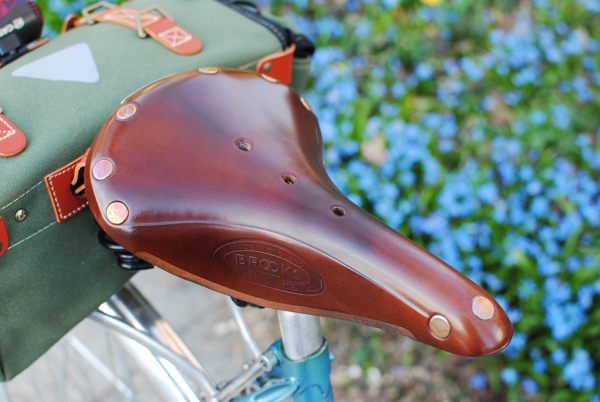
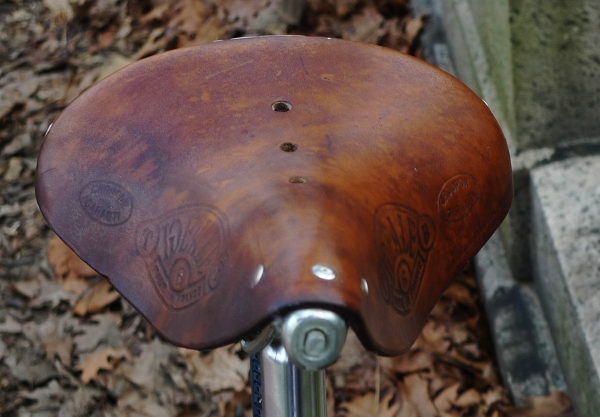
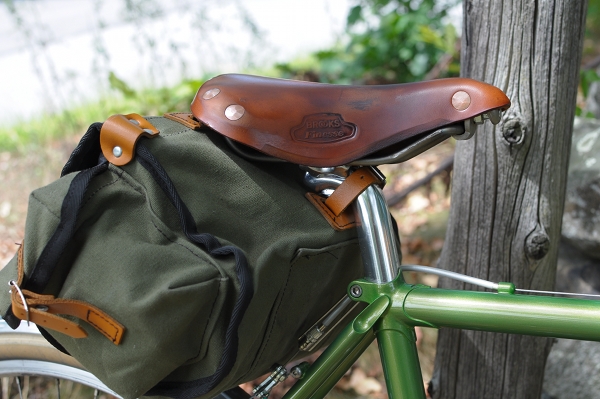
For the sake of keeping things women-specific, let's assume that the problem is not an overpadded saddle (which can cause bunching up in a way that is painful to both genders), and begin with the premise that you have a leather or plastic saddle with minimal padding. With most new saddles there is a break-in period, and it is normal if your butt feels sore on the first ride, or even several rides. But if it still hurts just the same after a reasonable break-in period, and the pain feels to be the result of pressure on the sit bones, then the saddle may be wrong for your derriere. For women, the problem tends to be choosing a too-narrow saddle. Women typically have wider sit bones than men and also tend to be less aggressive cyclists, which puts more pressure on their behinds. If your butt hurts where the sitbones are, a wider saddle will usually solve the problem. Padding, on the other hand, is not usually effective. Light chamois padding as part of your cycling shorts can make an already comfortable ride more comfortable over long distances. But the more typical heavier padding usually makes things worse, not better.
Genital Discomfort
When riding an upright bicycle, a female cyclist should feel no genital discomfort, because that part of her body is not in contact with the saddle in a way that causes pressure. On the other hand, a roadbike - with its forward-leaning posture, will tilt the genital region directly onto the saddle. Female cyclists typically experience genital discomfort in one of two places: the labia (vaginal "lips") and the clitoral area.

Labia: When cycling on a roadbike, some women report that their vaginal lips bunch up and press painfully into the saddle - so much so, that after a long ride there can be abrasions and bleeding. While some recommend getting saddles with a cut-out in the center, this is not always effective: Every woman's anatomy is different and the cut-out may not be in the right place. Though it's pretty much impossible to keep loose folds of skin from shifting about while you're pedaling, you can avoid abrasions with generous applications of chamois cream or vaseline before you set off on your ride. Creams such as DZNuts that use tea tree oil as a main ingredient seem to be particularly effective. Vaseline works as well, but be aware that it can discolour leather saddles if it seeps through shorts. Others prefer to use baby powder or corn starch, but the few times I've tried this it was a mess. Another method to prevent severe chafing may be to wax or epilate (but not shave) the entire area. For some, coarse pubic hair contributes to abrasions and getting rid of it improves things.
 
Clitoral Region: An even more difficult issue to deal with is clitoral pain. This is a problem that you either have or you don't, depending on your anatomy. For some women the location is safely out of harm's way, while for others it presses directly into the hard nose of the saddle. In the event of the latter, chamois cream is not sufficient to alleviate the discomfort that ensues. Some recommend tilting the nose down, but this is not always possible, as doing so can cause the cyclist to slide forward, putting more pressure on her hands and making the whole riding position uncomfortable.   The only solution here is to find a saddle that works through personal trial and error, which can be frustrating and expensive. I've suffered through this particular problem on and off with my Brooks B17S saddle since last Spring. Then I tried the Gilles Berthoud "Marie Blanque" and the problem disappeared entirely. Some also say that the Brooks "S" road saddles actually make this problem worse, not better, since the hard nose of these saddles does not just end sooner, but starts sooner. There are other suggestions out there for specific saddles that could solve this problem, including Terry saddles and "noseless" saddles. But the suggestions are all based on personal experiences of individual women and it is simply impossible to find a single solution for everyone, given the inconsistent location of this particular body part.
Recurring Infections
Female cyclists can be prone to yeast infections and urinary tract infections (UTIs). The causal factors underlying both types of infections are numerous, and contrary to what some believe, they are not necessarily due to poor hygiene. Of course, showering both immediately before and after a strenuous ride will lower the risk of infections, but most women who get them are already doing this. Often, synthetic shorts or underwear could be to blame: bacteria thrives underneath synthetic fabrics, even when the garments are advertised otherwise. 
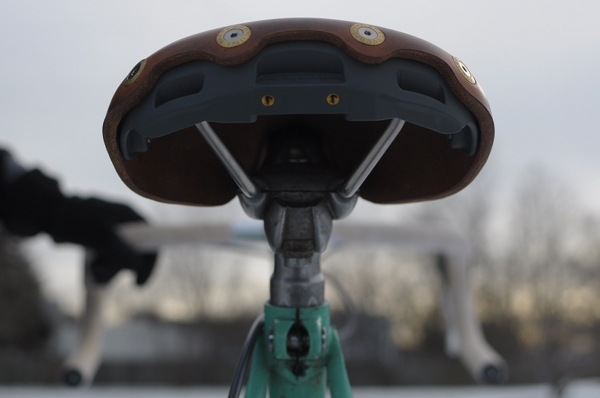
If you get recurring yeast infections or UTIs when you cycle, consider wearing exclusively silk or wool underwear and wool cycling shorts. And definitely consider a suspended leather saddle - which unlike other saddles, is breathable. Natural fabrics, good ventilation and moisture wicking are key here. It also helps to use simple soaps (made of actual soap, not perfumed body washes or moisturising soaps) and to avoid artificially perfumed sprays or lotions in or around your vaginal area. Be especially cautious on hot and humid days, as well as on days during which there are drastic weather changes - infections are more likely to occur at these times.
Menstruation
As any exercise, cycling can relieve menstrual cramps and counter PMS symptoms - so if you're up to cycling for sport during your period there is no reason not to do it. But straddling a bicycle saddle for hours while menstruating can present its own set of challenges. Blood flow increases during exercise, so if you are planning on a long ride, it's a good idea to change your tampon or sanitary napkin more frequently than usual. If you don't use tampons, then there is also the issue of blood being an irritant, with the potential to cause abrasions and infection.

Evolve Bike Seat
One way to avoid this is to shower right before your ride, then take wet naps with you and stop every hour in a restroom facility to clean up and change your sanitary napkin. If that sounds like too much trouble, consider using tampons or avoiding cycling for sport during menstruation - especially if you are prone to the abrasions and infections discussed earlier.
More at the: http://lovelybike.blogspot.com/