Wednesday, August 8, 2012

Women's Suffrage and the Biking Suffragettes

First of all, what is a suffragette?  Hmmm I wondered, then found out that it comes from the word Suffrage. Well according to Wikipedia:  It is the right to vote gained through the democratic process... among other rights. Well having said that, the suffragettes and their movement came to be towards the end of the 19th and beginning of the 20th centuries.

The struggle to achieve equal rights for women is often thought to have begun, in the English-speaking world, with the publication of Mary Wollstonecraft's A Vindication of the Rights of Woman (1792). During the 19th century, as male suffrage was gradually extended in many countries, women became increasingly active in the quest for their own suffrage. Not until 1893, however, in New Zealand, did women achieve suffrage on the national level. Australia followed in 1902, but American, British, and Canadian women did not win the same rights until the end of World War I.
The United States
The demand for the enfranchisement of American women was first seriously formulated at the Seneca Falls Convention (1848). After the Civil War, agitation by women for the ballot became increasingly vociferous. In 1869, however, a rift developed among feminists over the proposed 15th Amendment, which gave the vote to black men. Susan B. Anthony, Elizabeth Cady Stanton, and others refused to endorse the amendment because it did not give women the ballot. Other suffragists, however, including Lucy Stone and Julia Ward Howe, argued that once the black man was enfranchised, women would achieve their goal.
As a result of the conflict, two organizations emerged. Stanton and Anthony formed the National Woman Suffrage Association to work for suffrage on the federal level and to press for more extensive institutional changes, such as the granting of property rights to married women.  Stone created the American Woman Suffrage Association, which aimed to secure the ballot through state legislation. In 1890 the two groups united under the name National American Woman Suffrage Association (NAWSA). In the same year Wyoming entered the Union, becoming the first state with general women's suffrage (which it had adopted as a territory in 1869).
As the pioneer suffragists began to withdraw from the movement because of age, younger women assumed leadership roles. One of the most politically astute was Carrie Chapman Catt, who was named president of NAWSA in 1915. Another prominent suffragist was Alice Paul. Forced to resign from NAWSA because of her insistence on the use of militant direct-action tactics, Paul organized the National Woman's Party, which used such strategies as mass marches and hunger strikes. Perseverance on the part of both organizations eventually led to victory. On August 26, 1920, the 19th Amendment granted the ballot to American women.
Great Britain
In Great Britain the cause began to attract attention when the philosopher John Stuart Mill presented a petition in Parliament calling for inclusion of women's suffrage in the Reform Act of 1867. In the same year Lydia Becker (1827 –90) founded the first women's suffrage committee, in Manchester. Other committees were quickly formed, and in 1897 they united as the National Union of Women's Suffrage Societies, with Millicent Garret Fawcett (1847 –1929) as president. Like their American counterparts, the British suffragists struggled to overcome traditional values and prejudices. Frustrated by the prevailing social and political stalemate, some women became more militant. Emmeline Pankhurst, assisted by her daughters Christabel and Sylvia, founded the Women's Social and Political Union in 1903.   Her followers, called "suffragettes," heckled politicians, practiced civil disobedience, and were frequently arrested for inciting riots. When World War I started, the proponents of women's suffrage ceased their activities and supported the war effort. In February 1918 women over the age of 30 received the right to vote. Suffrage rights for men and women were equalized in 1928.
Other Countries
European countries such as Finland (1906), Norway (1913), and Denmark and Iceland (1915) granted women the vote early in the 20th century. Other continental powers were quick to accord women the right to vote at the end of World War I. The Union of Soviet Socialist Republics and the Netherlands granted suffrage in 1917; Austria, Czechoslovakia, Poland, and Sweden in 1918; and Germany and Luxembourg in 1919. Spain extended the ballot to women in 1931, but France waited until 1944 and Belgium, Italy, Romania, and Yugoslavia until 1946. Switzerland finally gave women the vote in 1971, and women remained disenfranchised in Liechtenstein until 1984.
In Canada women won the vote in Alberta, Manitoba, and Saskatchewan in 1916; after federal suffrage was achieved in 1918, the other provinces followed suit, the last being Quebec in 1940. Among the Latin American countries, national women's suffrage was granted in 1929 in Ecuador, 1932 in Brazil, 1939 in El Salvador, 1942 in the Dominican Republic, 1945 in Guatemala, and 1946 in Argentina. In India during the period of British rule, women were enfranchised on the same terms as men under the Government of India Act of 1935; following independence, the Indian Constitution, adopted in 1949 and inaugurated in 1950, established adult suffrage.
In the Philippines women received the vote in 1937, in Japan in 1945, in China in 1947, and in Indonesia in 1955. In African countries men and women have generally received the vote at the same time, as in Liberia (1947), Uganda (1958), and Nigeria (1960). In many Middle Eastern countries universal suffrage was acquired after World War II. In some countries, such as Saudi Arabia, there is no suffrage at all, and in others, such as Kuwait, it is very limited and excludes women completely.

Thanks to:
The bicycle escape, londonmet.ca.uk, redstate, goskyderide, annielondonderry.com.

Tuesday, August 7, 2012

Then and Now


Alirio and Santiago

Oscar & Alirio
I got a hold of a few interesting pictures of my father-in-law from when he was younger. When riding a bike in South America or at least in Colombia's capital was completely normal as it was to commute on a bicycle.  Just like in Copenhagen and Amsterdam in the 20s, 30s, 40s and 50s. I would like to know at what point the automobile displaced the biker and the pedestrian in favor to the big and invasive highway. One of my earlier posts (video) show how Amsterdam citizens started losing ground against the motor vehicle, but is also shows how they decided to retake the public spaces and give them back to the pedestrian and the bikes. 

In any case, that is unfortunately not the situation in South America. Even though Bogota and the country in general are some of the most bicycle friendly places in the continent, there are for every pedestrian and for every biker, one redneck driver with a huge sense of entitlement.  I wish I had more room here to show you some images of the great public infrastructure accomplished during the government of Enrique Peñalosa and Antanas Mockus; two of the greatest Mayors of Bogota.  Things have changed so drastically since they passed the baton.  Communist-minded governments of today preach for the masses, but don't seem to work for the people.  What a sad state of affairs.
I have deviated from my original thought. My whole point is that as I discovered the pictures, I wanted to create a post to show a side by side comparison of Alirio then and now.  Back then he commuted with his friend Santiago Cruz. Today as he is here in Anchorage visiting us, my wife took a picture of us riding our bikes to the super.

Female Anatomy and Saddle Discomfort

From the Lovely Bicycle:

Male readers: you may want to skip this one. Of course if you feel up to it, you are welcome to keep reading. But don't say I didn't warn you.

Female readers: I've had email exchanges with so many of you about "women's issues" with bicycle saddles, and it's amazing how much embarrassment there is among us (and I include myself) when it comes to discussing our bodies - especially given how common these problems are. While with men, we can read and hear all about perineal this and genital that, with women it's all hush-hush and seldom addressed in a manner explicit enough to be helpful. So I'll try to get over my own embarrassment, and write about it in detail here.

There are many different kinds of female-specific saddle problems and I will organise them into several categories: posterior discomfort, genital discomfort, infections, and menstruation.
Posterior Discomfort
For the sake of keeping things women-specific, let's assume that the problem is not an overpadded saddle (which can cause bunching up in a way that is painful to both genders), and begin with the premise that you have a leather or plastic saddle with minimal padding. With most new saddles there is a break-in period, and it is normal if your butt feels sore on the first ride, or even several rides. But if it still hurts just the same after a reasonable break-in period, and the pain feels to be the result of pressure on the sit bones, then the saddle may be wrong for your derriere. For women, the problem tends to be choosing a too-narrow saddle. Women typically have wider sit bones than men and also tend to be less aggressive cyclists, which puts more pressure on their behinds. If your butt hurts where the sitbones are, a wider saddle will usually solve the problem. Padding, on the other hand, is not usually effective. Light chamois padding as part of your cycling shorts can make an already comfortable ride more comfortable over long distances. But the more typical heavier padding usually makes things worse, not better.
Genital Discomfort
When riding an upright bicycle, a female cyclist should feel no genital discomfort, because that part of her body is not in contact with the saddle in a way that causes pressure. On the other hand, a roadbike - with its forward-leaning posture, will tilt the genital region directly onto the saddle. Female cyclists typically experience genital discomfort in one of two places: the labia (vaginal "lips") and the clitoral area.

Labia: When cycling on a roadbike, some women report that their vaginal lips bunch up and press painfully into the saddle - so much so, that after a long ride there can be abrasions and bleeding. While some recommend getting saddles with a cut-out in the center, this is not always effective: Every woman's anatomy is different and the cut-out may not be in the right place. Though it's pretty much impossible to keep loose folds of skin from shifting about while you're pedaling, you can avoid abrasions with generous applications of chamois cream or vaseline before you set off on your ride. Creams such as DZNuts that use tea tree oil as a main ingredient seem to be particularly effective. Vaseline works as well, but be aware that it can discolour leather saddles if it seeps through shorts. Others prefer to use baby powder or corn starch, but the few times I've tried this it was a mess. Another method to prevent severe chafing may be to wax or epilate (but not shave) the entire area. For some, coarse pubic hair contributes to abrasions and getting rid of it improves things.
 
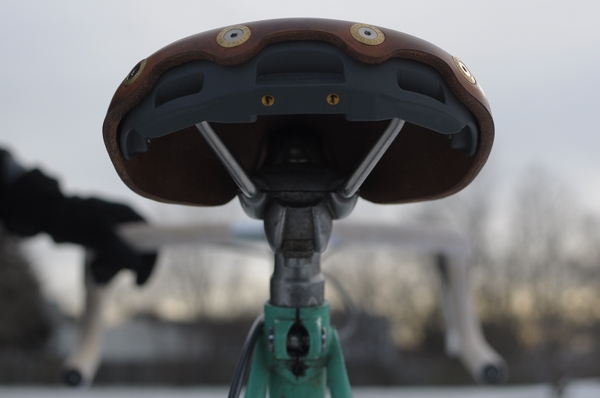
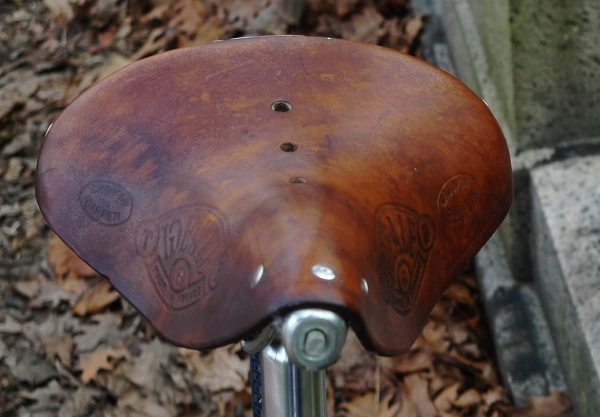
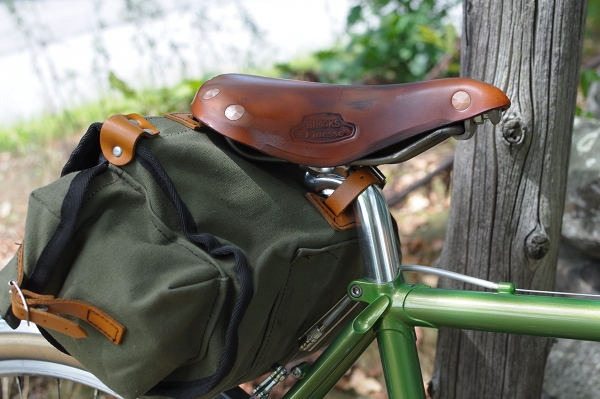
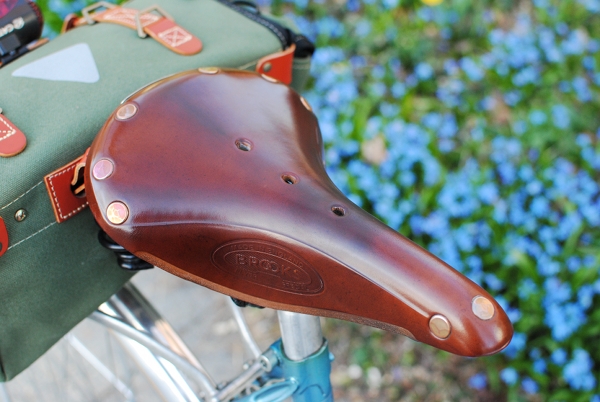
Clitoral Region: An even more difficult issue to deal with is clitoral pain. This is a problem that you either have or you don't, depending on your anatomy. For some women the location is safely out of harm's way, while for others it presses directly into the hard nose of the saddle. In the event of the latter, chamois cream is not sufficient to alleviate the discomfort that ensues. Some recommend tilting the nose down, but this is not always possible, as doing so can cause the cyclist to slide forward, putting more pressure on her hands and making the whole riding position uncomfortable.   The only solution here is to find a saddle that works through personal trial and error, which can be frustrating and expensive. I've suffered through this particular problem on and off with my Brooks B17S saddle since last Spring. Then I tried the Gilles Berthoud "Marie Blanque" and the problem disappeared entirely. Some also say that the Brooks "S" road saddles actually make this problem worse, not better, since the hard nose of these saddles does not just end sooner, but starts sooner. There are other suggestions out there for specific saddles that could solve this problem, including Terry saddles and "noseless" saddles. But the suggestions are all based on personal experiences of individual women and it is simply impossible to find a single solution for everyone, given the inconsistent location of this particular body part.
Recurring Infections
Female cyclists can be prone to yeast infections and urinary tract infections (UTIs). The causal factors underlying both types of infections are numerous, and contrary to what some believe, they are not necessarily due to poor hygiene. Of course, showering both immediately before and after a strenuous ride will lower the risk of infections, but most women who get them are already doing this. Often, synthetic shorts or underwear could be to blame: bacteria thrives underneath synthetic fabrics, even when the garments are advertised otherwise. 
If you get recurring yeast infections or UTIs when you cycle, consider wearing exclusively silk or wool underwear and wool cycling shorts. And definitely consider a suspended leather saddle - which unlike other saddles, is breathable. Natural fabrics, good ventilation and moisture wicking are key here. It also helps to use simple soaps (made of actual soap, not perfumed body washes or moisturising soaps) and to avoid artificially perfumed sprays or lotions in or around your vaginal area. Be especially cautious on hot and humid days, as well as on days during which there are drastic weather changes - infections are more likely to occur at these times.
Menstruation
As any exercise, cycling can relieve menstrual cramps and counter PMS symptoms - so if you're up to cycling for sport during your period there is no reason not to do it. But straddling a bicycle saddle for hours while menstruating can present its own set of challenges. Blood flow increases during exercise, so if you are planning on a long ride, it's a good idea to change your tampon or sanitary napkin more frequently than usual. If you don't use tampons, then there is also the issue of blood being an irritant, with the potential to cause abrasions and infection.

Evolve Bike Seat
One way to avoid this is to shower right before your ride, then take wet naps with you and stop every hour in a restroom facility to clean up and change your sanitary napkin. If that sounds like too much trouble, consider using tampons or avoiding cycling for sport during menstruation - especially if you are prone to the abrasions and infections discussed earlier.
More at the: http://lovelybike.blogspot.com/

Thursday, July 19, 2012

Bicycles belong on the Streets


source: puregraffiti.com
This post is a tribute to:
      • the graffiti
      • the bicycle and its rider
        • the street artist
Bicycles belong out there on the streets and so do graffiti (Italian plural of graffito).  Only those that are willing to really be part of the culture and life of a city such as the bicyclist and the graffiti artist deserve to be recognized.
The city belongs to them.  The rest are only borrowers...shy expectators.  If you want to really be a part and contribute to the life and fabric of a place, then step on its streets, walk its paths, bike its trails, watch its art, smell its aromas, buy locally.

How can you call yourself a Bostonian if you don't know what Boston smells like? You should know what the manhole covers look like in your city; after all, you are paying for them. Taste your place, be part of it, leave a mark, feel its beat; every place has one.  I'll leave you with this collection of street art:  Hopefully your town has some interesting graffiti art like these:


Source: Adidas ad - Capetowndailyphoto.com

Source: Alttransport

Source: Amy Martino (Bicycles)

Source ofneto.com (anonimous)


By Arys.es

Source: bagabondjourney.com


Source: Flickr user David Drexler (Bicycle Man)

Source: nicomachus (bicycle stencil)

Source: flickrhivemind.net (Bikeshop in Denver)

Source: Unurth.com

By Caleb Loadbear sketch

Source: sergi10del77.blogspot Brasil

By Noah Hoose (Headless Horseman)

At: Joah's Raw Food (Bananawonder)

By Kosule Masuda

Source: Caroline Tucker - shazly.tumblr.com

Source: Street Art Utopia -  Stinkfish

Source: The Giant Blog

Source: throughthestreetsofanywhere.wordpress.com

Source: throughthestreetsofanywhere.wordpress.com

Source: treadlyandme.tumblr
Enjoy - -

Wednesday, July 11, 2012

Sustainable Streets by Janette Sadik-Khan

Transforming NYC Streets: A Conversation with Janette Sadik-Khan

Since taking over as New York City's Commissioner of the Department of Transportation in mid-2007, Janette Sadik-Khan has taken on the challenge of making NYC streets more bike & pedestrian friendly while emphasizing livable streets and re-orienting them to accommodate all modes. She and her staff have done it quickly with innovative concepts, thinking outside the box and drawing on successful street designs from around the world to come up with a NYC model that is already changing the way our city feels.


In our exclusive Streetfilms interview, she talks with The Open Planning Project's Executive Director, Mark Gorton, about some of the highlights her department has achieved in a very short period of time including a physically-separated bike lane on Ninth Avenue, multiple pedestrian plazas (including Madison Square and Broadway Boulevard), new efforts to boost efficiency and speeds on some bus routes, and the city's phenomenally successful, Ciclovia-style closure "Summer Streets".

Tuesday, July 10, 2012

Of Bicycles and Drug Money

Source: Cycling Inquisition blog
Recently the topic of Pablo Escobar has become to resurface with the opening of a new Colombian Soap Opera by its name: Pablo Escobar - El Patrón del Mal. or Pablo Escobar, the Lord of Evil.
Source: Crunchtees
Fewer people nowadays don't know who Escobar was, but for us Colombians that had to grow up with the cartel wars and thus with the bombings, the extravagant silliness, the news, the uncertainty and the inflation that drug money fueled, that name and the names of many other drug lords are latent in memory.  Pablo was definitely an icon.  You can ask around the world what his name means for them and you will hear dozens, maybe hundreds of different adjectives associated to it. For me, the name meant power, determination, suicide.  The picture above shows how this type of money permeated even the most noble of inventions.
Source: Cycling Inquisition blog


Bicycling and the races were not unaffected by the cartels. Not by his anyway. Pablo liked speed. All of his family liked the races; car races, horse races, flying, bike races and since his brother was into bicycles, Escobar saw it quite natural to just give his brother Roberto (osito) a bicycle? oh no... an entire bicycle factory. Bicicletas Ossito were the sponsors of bike tours around Colombia.  Made in Manizales, in the jurisdiction of Caldas, Ossitto made all kinds of bicycles, but was most notorious for its road bikes, which participated in some of the most important tours while riders such as Gonzalo Marín wore Jerseys and pants that advertised Pablo Escobar as a political figure.
Autos & Pista Magazine 1979

Escobar also donated money to launch athletes to the Tour de France, which reminds me of the Medici family and the sponsorships of artists during the Renascence in Italy. Perhaps car races were the most favored by El Patrón, but this didn't preclude the two to intermingle.  Several of Colombia's best professional cyclists found themselves associated to and victimized by the drug cartels.  Here are some of their names: Roberto Escobar (Pablo's brother), Gonzalo Marín, Alfonzo Flores, Armando Aristizabal, Juan Carlos Castillo, Rafael Tolosa.

Thanks to: Cycling Inquisiton and Carla Toscano's interview with Pablo Escobar